
May 13, 2026
For years, the agricultural industry has explained the benefits of seaweed-based biostimulants through a familiar lens: plant hormones.
It was a convenient explanation.
It was also wrong.
As scientific understanding has evolved, a clearer picture has emerged. One that challenges long-held assumptions and reframes the role of these technologies in modern agriculture.
Seaweed biostimulants don’t act as hormone replacements.
They do something far more powerful.
Early research into seaweed extracts suggested that their effects on plant growth, improved vigor, enhanced rooting, and increased yield, were linked to naturally occurring plant hormones.
It made intuitive sense. Apply a product containing growth regulators, and the plant responds.
But advances in analytical science have since revealed a critical flaw in this thinking. The concentrations of plant hormones found in seaweed extracts are extremely low, far below the threshold required to trigger physiological responses in plants, as demonstrated in recent EBIC and peer-reviewed studies. (EBIC, 2023)
In other words, even when present, these hormones are not driving the outcomes observed in the field.
The industry had been attributing cause to the wrong mechanism.

If not hormones, then what explains the consistent performance benefits? The answer lies in the plant itself.
Recent research shows that seaweed-based biostimulants modulate gene expression and reconfigure plant metabolic pathways rather than acting as external hormone inputs. (EBIC, 2023)
Rather than acting externally, they:
This is not supplementation. It is biological activation.
One of the most important concepts to emerge from recent research is molecular priming.
When a plant is treated with a seaweed extract, it undergoes subtle but significant changes at the molecular level. Genes associated with stress tolerance, metabolism, and growth are recalibrated. Metabolites linked to protection and resilience increase. Harmful stress responses are suppressed.
The plant is not simply reacting better; it is prepared in advance.
This primed state enables crops to maintain performance under conditions such as drought, heat, or nutrient limitation. All factors that are becoming increasingly common in today’s agricultural systems.
At the heart of this mechanism are complex carbohydrates and bioactive compounds unique to seaweeds.
These molecules act as signals, not inputs, initiating cascades of biological activity within the plant. Unlike traditional nutrients or hormones, they do not supply or substitute. They inform and activate.
Critically, their impact is shaped by how they are produced.
The species of seaweed, the environment in which it grows, and the extraction process used all influence the composition and functionality of these compounds. Even small changes in processing conditions can significantly alter performance outcomes.
This is why not all seaweed extracts are created equal, and why formulation science is becoming a defining factor in the next generation of biostimulants.
As understanding of these mechanisms deepens, the industry is beginning to differentiate based on how effectively bioactive compounds are preserved and activated. Precision in extraction is no longer a processing step. It is a performance driver.
Technologies such as BioSwitch™ demonstrate how this shift is being realized, translating the complexity of seaweed-derived compounds into consistent, scalable outcomes across crop systems. By focusing on how these molecules are preserved and activated, rather than simply extracted, they represent a new standard for delivering resilience in modern agriculture.
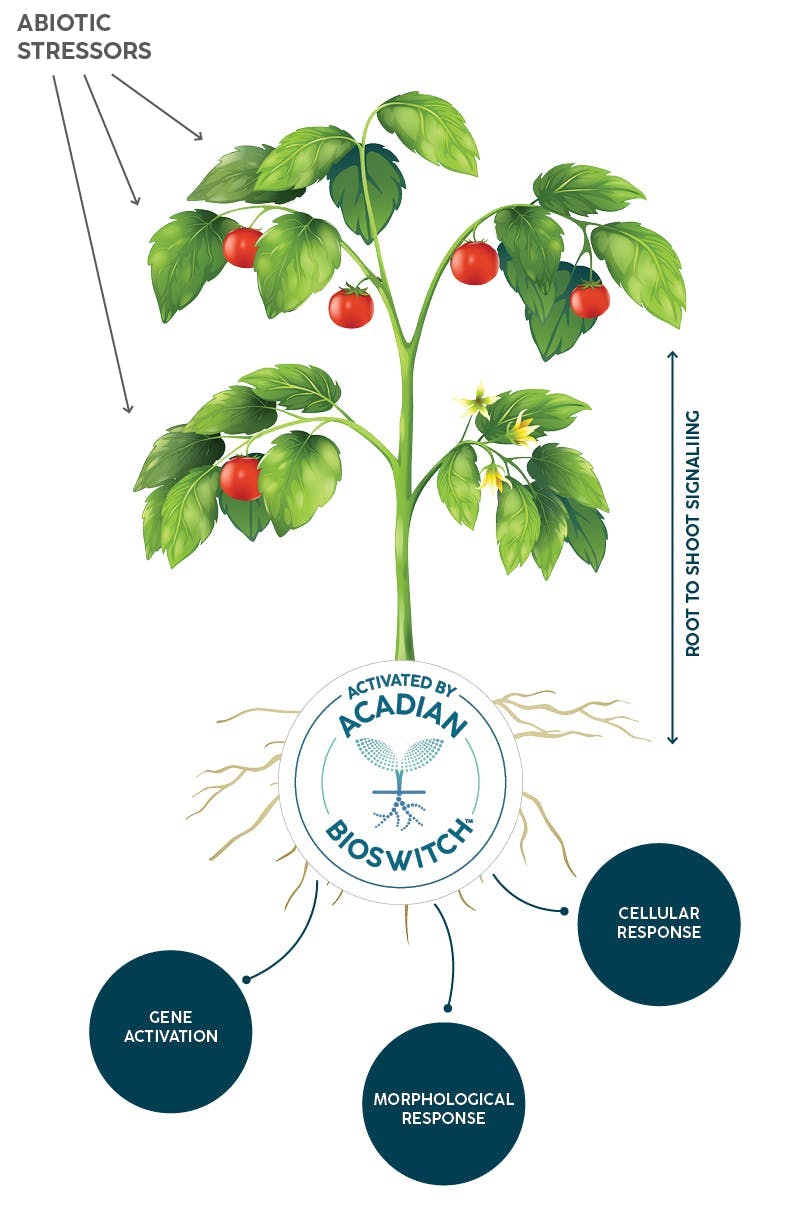
Understanding the true mode of action of seaweed biostimulants reframes their value.
These are not products that replace inputs. They are technologies that optimize the plant’s ability to use them.
In practice, this has led to:
Field and controlled studies have shown improvements in nutrient use efficiency. (EBIC, 2023)

The persistence of the hormone myth reflects a broader tendency in agriculture. To simplify complex biological systems into familiar categories.
But biology is not linear. And the future of agriculture will not be built on simplified assumptions.
Seaweed-based biostimulants represent a different paradigm. One where performance is driven not by what we add, but by what we enable.
They don’t override plant systems. They enhance them.
They don’t dictate outcomes. They unlock potential.
As research continues to uncover the molecular networks influenced by these technologies, the opportunity becomes clear.
We are moving toward a more precise, biology-driven model of agriculture. One that aligns performance with sustainability, and innovation with natural systems.
Dispelling the hormone myth is not just about correcting the science.
It is about unlocking a new understanding of how plants can perform in a changing world.
And in that understanding lies the next frontier of agricultural innovation. The future of agriculture will be defined not only by biological insight, but by the ability to deliver that insight consistently at scale.
Further Reading:
European Biostimulants Industry Council (EBIC). Recent insights into the mode of action of seaweed-based plant biostimulants. January 2023.
Sujeeth, N. et al. (2022). Current Insights into the Molecular Mode of Action of Seaweed-Based Biostimulants. International Journal of Molecular Sciences.
Goñi, O. et al. (2021). Enhancing Nitrogen Use Efficiency in Crops Using Ascophyllum nodosum Extracts. Frontiers in Plant Science.